Somewhere between the late seventies and the nineties, fat became public enemy number one.
The message was simple: fat makes you fat. Eat less fat, weigh less.
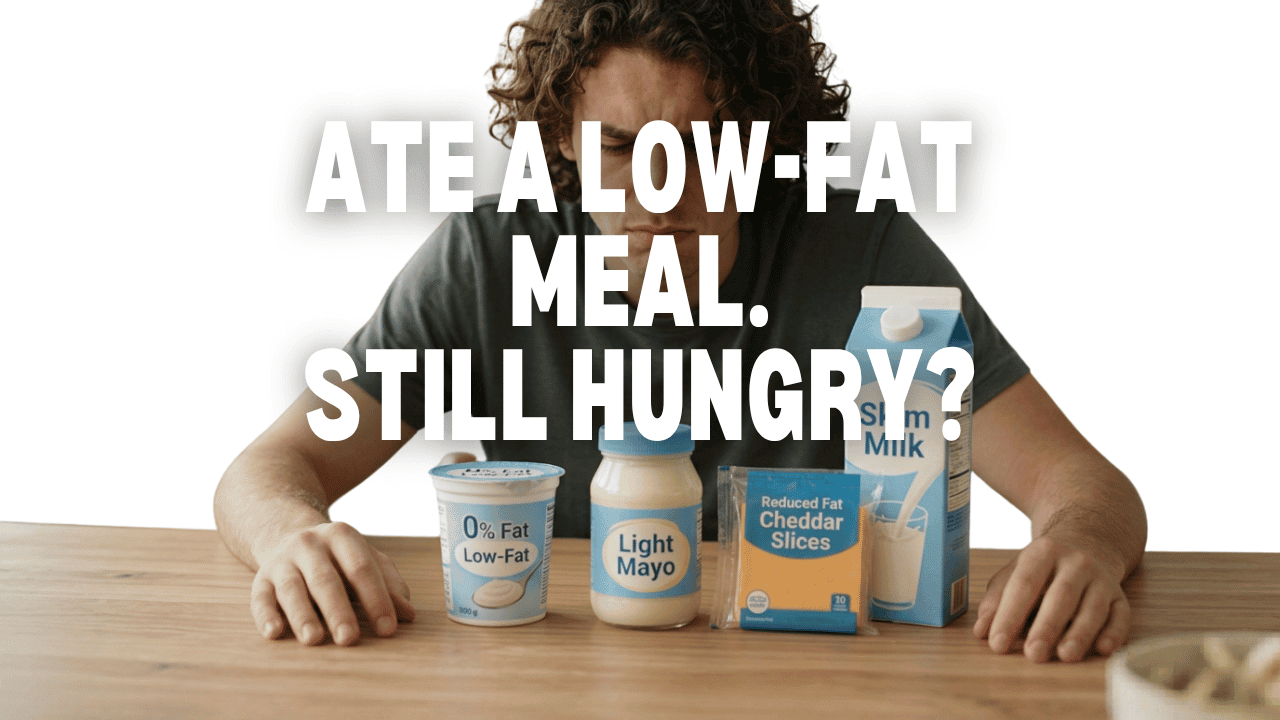
So the food industry obliged. Low-fat yogurt. Reduced-fat peanut butter. Fat-free salad dressing. Light crackers. Diet everything.
Sales went up. Obesity rates also went up during the same period. That doesn't prove one caused the other, but it does suggest that the low-fat era didn't work out quite as people had hoped.
The problem wasn't that people lacked willpower. The problem was that removing fat from food doesn't just make it "lighter." It fundamentally changes how the food behaves in your body, and what manufacturers put back in to compensate makes things considerably worse.
Fat is one of the signals your body uses to feel full
When fat reaches your small intestine during digestion, it triggers the release of satiety hormones. These hormones signal to your brain that you've eaten something substantial and can stop.
Research on how dietary fat affects appetite has consistently found that diets low in fat are associated with more persistent hunger, partly because there's less fat available in the intestine to trigger these satiety mechanisms.
In plain terms, fat is one of the inputs your body uses to know it's done eating. Once you take it out, the signal gets weaker.
This isn't a design flaw in your hunger system. Your body learned to read fat as a reliable indicator of a nutrient-dense meal because for most of human history, fat came packaged inside whole foods like meat, eggs, nuts, and fish. The problem started when we began eating foods engineered to mimic real food while removing the components that make real food satisfying.
When fat comes out, something else goes in
This is the part I like to keep at the back of my mind.
Removing fat from food changes the taste, texture, and mouthfeel in ways most people won't enjoy. Fat is what makes a yogurt creamy, a dressing rich, a cracker satisfying to bite. Without it, food tastes thin and unsatisfying.
To fix this, manufacturers add other things.
Usually sugar or some form of sweetener. Sometimes thickeners like modified corn starch, gums, or maltodextrin to recreate the texture fat would have provided. Sometimes artificial flavors to compensate for the flavor fat carries.
Check the ingredient list on a low-fat flavored yogurt container and compare it to the full-fat plain version. The low-fat one typically has more added sugar (sometimes significantly more), plus a longer list of stabilizers and texture additives. The full-fat plain one often has fewer ingredients and no added sugar at all.
You paid for "healthy" and got more sugar and a longer ingredient list.
Sugar doesn't satisfy hunger the way fat does
The added sugar in low-fat products creates its own problem.
Refined sugar enters your bloodstream quickly. You get a burst of energy, then a drop. For many people, that drop feels a lot like hunger, even if they ate not long ago. Ghrelin, the hunger hormone, rises again. You feel the pull to eat something.
This is the cycle that makes "diet" food so frustrating. You eat the low-fat version specifically to eat less, but it's designed in a way that makes you hungry again faster than the full-fat version would have.
I talked about how blood sugar swings drive hunger in Why You're Still Hungry After Eating. Low-fat foods with added sugar are one of the more reliable ways to trigger exactly that pattern.
The "light" label is almost always a red flag now
I've stopped reaching for anything that says light, reduced-fat, fat-free, or diet on the front. Because that label usually tells me the formula has been altered and something industrial has been added to compensate.
Check the label on reduced-fat peanut butter, for example. Regular peanut butter is peanuts (and maybe salt). Reduced-fat peanut butter fills the space the removed fat left with corn syrup solids, sugar, and modified corn starch. You end up with less fat, more sugar, and a longer ingredient list.
The same pattern shows up in:
- Low-fat salad dressings: fat removed, sugar and gums added
- Reduced-fat cheese: less fat, more starch
- Low-fat mayonnaise: fat removed, sugar and modified starch added, plus extra emulsifiers to hold the texture together
- Low-fat ice cream: fat removed, more sugar added plus gums and thickeners to fake the creaminess
In almost every category, 'reduced fat' just means something industrial got added to replace what was taken out.
Full-fat whole foods are not the enemy
Plain full-fat Greek yogurt.
A handful of nuts.
Eggs cooked in butter.
Avocado.
Sardines in olive oil.
These foods don't need much help. The fat is already there, along with the other nutrients that make a meal satisfying. The fat in them comes alongside protein, fiber (in the case of plants), and a short, recognizable ingredient list. Your digestive system knows how to handle them. The satiety signals fire properly. You eat, you feel satisfied, you move on.
This is not the same thing as eating deep-fried anything in large quantities. The low-fat movement spent decades conflating "fat in food" with "fat on body" but there's a distinction for sure.
I'm not anti-diet-advice as a category. I'm specifically suspicious of any product where the thing that was removed has been replaced with a list of industrial substitutes and then sold as healthier.
If the ingredient list is longer on the low-fat version than on the original, that's telling you something.
-4.png?width=2000&height=600&name=Vertical%20Version%20of%20Primary%20Logo%20(1)-4.png)