-4.png?width=2000&height=600&name=Vertical%20Version%20of%20Primary%20Logo%20(1)-4.png)
My Journey
75 Soft
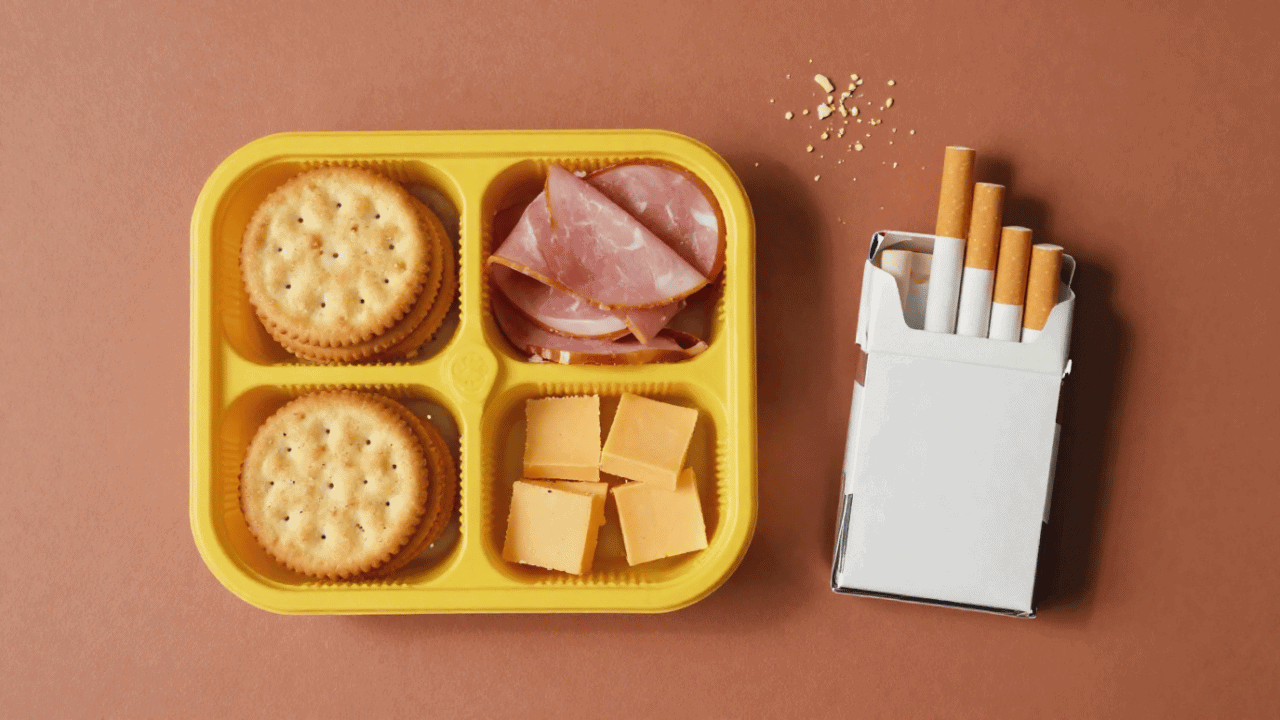

Sometime last year, I got a coupon for free Lunchables from my usual grocery store. And like any budget-friendly momma, I used it. Picked up a lunchable just because it was free. Now, at that time I had already started paying attention to food labels, so I spent several minutes looking through all the options they had. The ingredient lists were so long and honestly, I wasn't keen on any of them. I should have left it in the store's fridge.
I took it home, couldn't eat it and couldn't serve it to my kid. Ended up leaving it alone until it expired and then throwing it away. I hate the waste.
The store gave me another coupon for the same a couple of weeks later. That time I just let it go, unredeemed. I'd read enough labels by then to know I wasn't missing anything.
All this to say: check your labels and listen to your gut. So imagine my surprise when I saw in the news a few days ago that Lunchables has Big Tobacco's fingerprints all over it.
In 1985, Philip Morris, the tobacco giant behind Marlboro, acquired General Foods. A few years later it merged with Kraft to create the largest food company in North America, and inherited a product still in development: a brightly packaged lunch kit for kids that would become one of the most recognized food products in American history.
A new analysis of internal company documents, published June 3 in the American Journal of Public Health by UCSF professor Laura Schmidt, PhD, describes what happened next.
Philip Morris didn't just acquire Kraft and leave the food business alone. It systematically applied what it knew from tobacco to the food side. The strategy had a name: "technical synergies." Complete with a whole committee.
Innovations developed for cigarettes, shelf-stable packaging, flavor management technologies, research into how flavors are experienced in the brain, were repurposed to make food products at scale.
At a 1990 companywide R&D symposium, PMC's CEO put the company's product development philosophy in plain terms: "We don't create demand. We excavate it. We prospect for it. We dig until we find it."
The tobacco industry hadn't just spent decades selling cigarettes. It had spent decades running studies on how flavor lands in the brain, what keeps a person reaching for the next one, how to calibrate a product so the experience of consuming it generates its own demand.
Internal memos leading up to Lunchables' 1988 launch show the product was designed around a specific psychological insight: children want control.
"Lunchables aren't about lunch," one executive wrote. "It's about kids being able to put together what they want to eat, anytime, anywhere." The separate compartments weren't just a packaging choice. They were a deliberate play on the child's desire for autonomy.
They tested 17 prototypes on children, watching them interact with the product in what they called a "Food Playground," a room full of food with plastic and scissors, building versions of the product through interactive play.
They also studied the working mothers who typically purchased Lunchables, adding plastic windows to the packaging specifically because mothers felt better about the food when they could see what was inside. The bright yellow band around the box, one lead designer later explained, was designed to make it feel like a gift, "something precious to elevate its specialness." Every element was calculated.
But the detail that alarmed me was what happened when food scientists struggled to make the Low-Fat Lunchables version taste acceptable.
The artificial fats weren't working. So they turned to the tobacco division's neuroscientists. Using electroencephalographs (EEG), the same brain wave monitoring technology used in nicotine research, they ran sensory tests on consumers to figure out what was going wrong with the flavor experience and how to fix it.
The scientist they brought in, Frank Gullotta, had been conducting his neuroperception research in a secret laboratory in Germany, specifically to keep his work out of reach of US attorneys and tobacco regulators. He became, in the words of KGF's own product developers, "an absolutely key resource for us in this task."
They were measuring brain activity. For a kids' lunch kit.
This is the kind of engineering that goes into ultra-processed foods. Not "we added some salt and sugar" but a systematic, research-backed process designed to optimize palatability at a neurological level.
Lunchables are one product, but they're a window into a much broader pattern.
Philip Morris wasn't the only tobacco company that moved into food. R.J. Reynolds owned Nabisco and Del Monte during the same era. These companies brought the same infrastructure, the behavioral science, the flavor research, the optimization mindset, to the food supply.
By the time tobacco companies largely divested their food holdings around 2007, the ultra-processed food industry had already been shaped by their methods.
Today, UPFs make up nearly two-thirds of the calories consumed by US children.
A separate Tufts University study, also published last week, found that higher UPF consumption was associated with worse health outcomes even after researchers accounted for overall nutritional quality.
That suggests there may be something about ultra-processing itself that isn't fully captured by nutrients alone.
That finding closes the most common escape hatch in these conversations, which is "just check the nutrition label."
Because if the damage were only about sugar content or fat content, you could theoretically engineer a UPF that scores well nutritionally and causes no harm. But that's not what the research shows.
Two products can have identical macros and behave completely differently in your body depending on how processed they are.
Understanding that UPFs were deliberately engineered to drive consumption changes how you approach them.
You're not dealing with a failure of willpower when a highly processed food is hard to put down. You're dealing with a product that was specifically designed to be hard to put down, using decades of neuroscience research.
Reframing the situation matters because it shifts the question from "why can't I just eat less of this?" to "is this something I actually want to keep in my regular rotation?"
Pay attention to whether you feel satisfied after eating something, or whether you want more twenty minutes later. One of the consistent findings in UPF research is that they drive overeating in ways minimally processed foods don't, partly because of how they interact with the hormones that signal fullness. I wrote about the mechanics behind that in Why You're Still Hungry After Eating.
When you have kids in the picture, the practical question gets more specific: okay, but what do I actually pack?
You don't have to become the parent who cuts star shapes into everything but you can make some changes here and there.
Most kids aren't attached to Lunchables because they're specifically craving a particular brand. They're attached to the format, which you probably already have in their bento boxes.
The little compartments.
The mix-and-match pieces.
The feeling of building their own lunch.
You can recreate that with ordinary foods.
A few examples:
The pattern across all of these is the same: a protein, something fresh, something with a bit of crunch. No single right answer, just real ingredients assembled in a way that gives kids the same sense of control that made Lunchables appealing in the first place.
I'll be building out more specific meal ideas as I go, but if you want a starting framework for reading the labels on anything you're already packing, How to Tell If a Food Is Ultra-Processed in 5 Seconds is a good place to start.
If Lunchables are currently showing up five days a week, even swapping one or two lunches can make a huge difference. You don't have to overhaul everything at once, one swap that sticks is worth more than ten that don't.
A food product engineered with tobacco neuroscience to maximize its appeal to children is now among the most consumed foods in the United States.
More and more people are starting to ask questions about how these products are made. I know I did. If you're here, you already started asking the right questions.
Eat mostly real food. The less engineering involved, the better.